
Hospital Laundry Service & Linen Continuity
The problem
A hospital does not consume linen the way a hotel does. A hotel can delay a room turnover; a hospital cannot delay a bed change after a discharge, a surgical list, or an isolation case. Linen in a hospital is not an amenity — it is part of the clinical workflow. When the supply of clean linen stops, wards improvise: they hold soiled linen longer than they should, ration bed changes, borrow stock between departments, or quietly lower the standard. None of those improvisations appear in a report. All of them carry risk.
This is why the right way to evaluate a hospital laundry service is not price per kilogram. It is a single question: does clean linen keep arriving when something goes wrong? That property is what we call linen continuity — and it has to be engineered, because it does not happen by goodwill.
Why it matters
Linen failures in hospitals are rarely dramatic. They accumulate. A washer goes down for two days and the buffer stock absorbs it — once. A long holiday compresses pickup schedules. An outbreak response doubles isolation linen demand within a week. A renovation closes one lift and the trolley route through the building changes. Each event is survivable on its own; the question is whether the laundry operation behind the hospital was designed to absorb several of them at once.
We have operated through demand surges during outbreak responses, through equipment disruptions, and through hospital expansions that redrew the linen workflow mid-contract. The lesson from more than 10 years of healthcare laundry, across more than 50 hospitals in Thailand, is consistent: continuity fails at the seams — at handovers, schedules, buffers, and assumptions — not at the washer drum.
How PEO approaches it
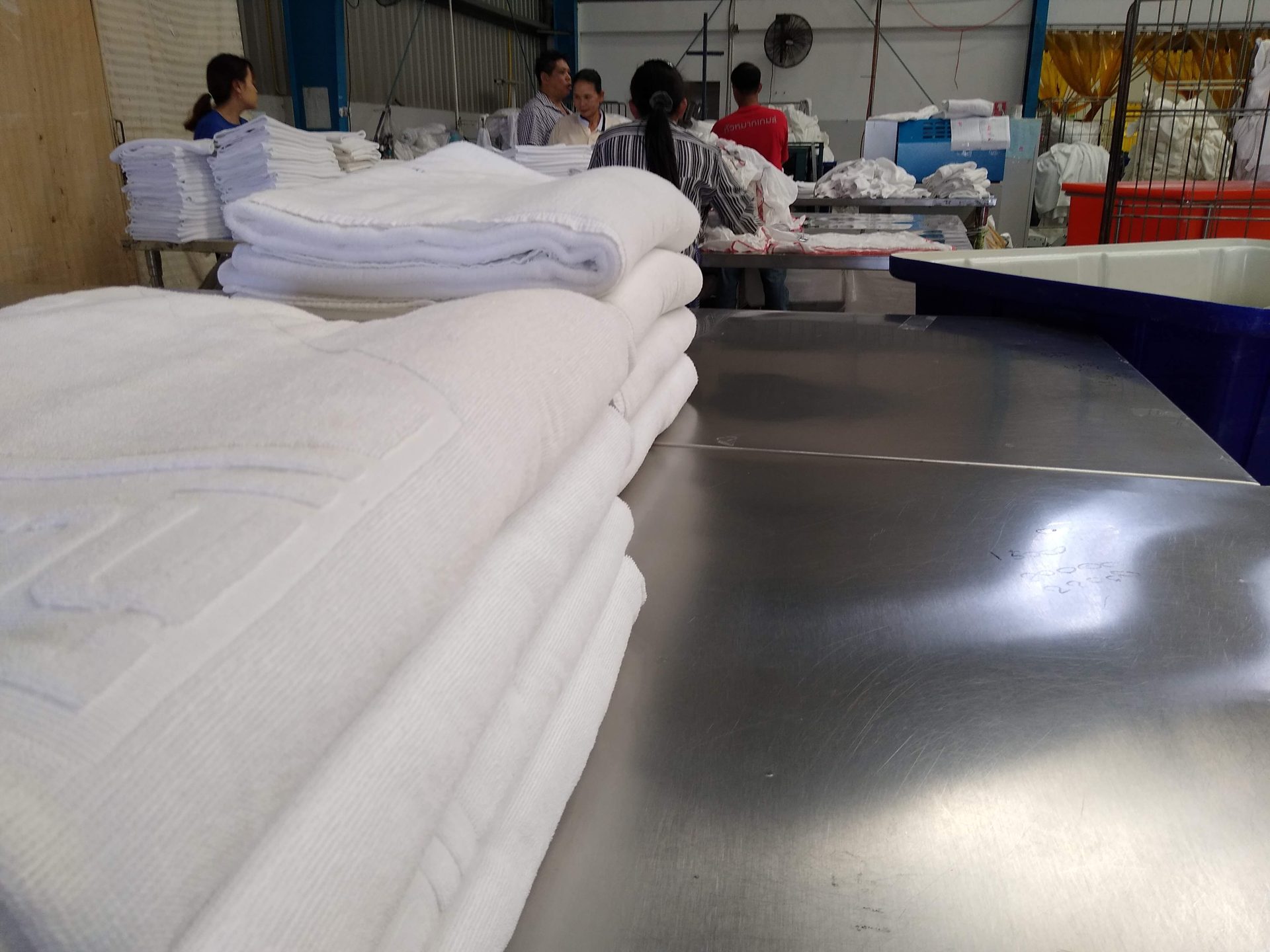
Ideal Laundry builds hospital linen services around continuity rather than throughput. In practice that means four design decisions, made before service begins:
One continuous flow
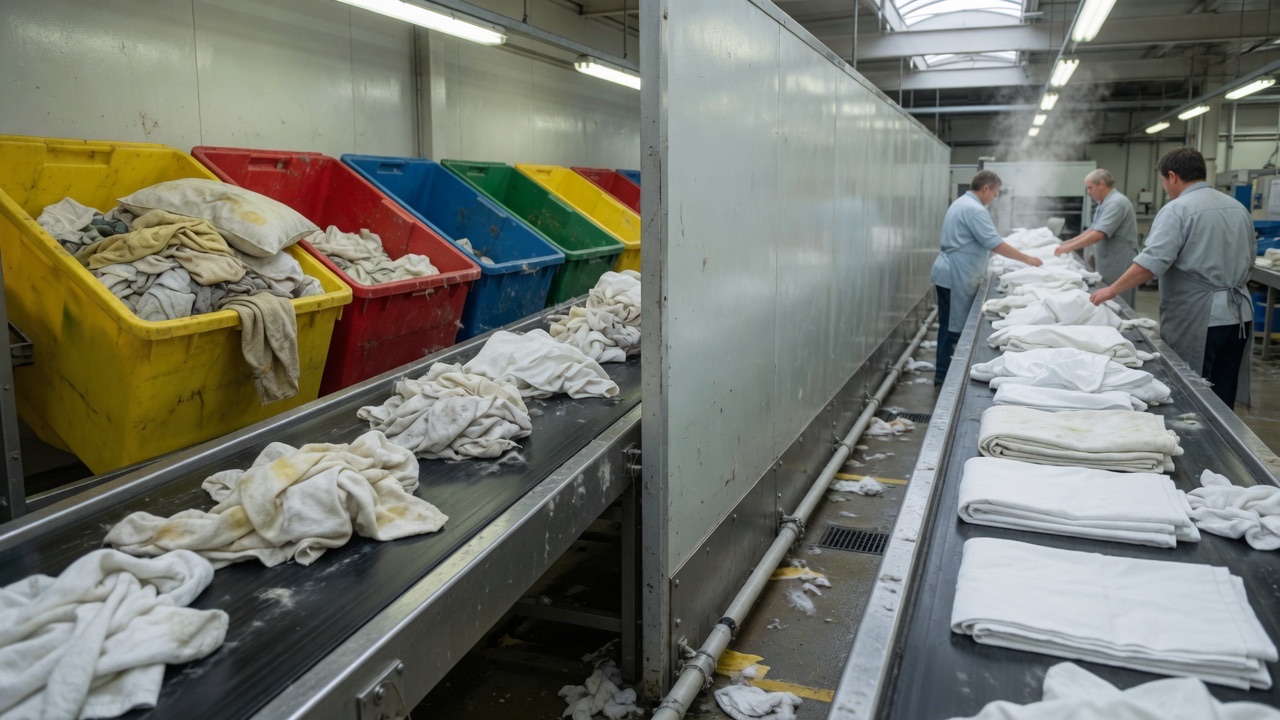
Collect → Segregate → Process → Inspect → Deliver — one direction, no shared paths between clean and contaminated linen. Hygiene incidents are the fastest way to lose capacity overnight. (See clean vs. contaminated flow.)
Buffer stock is calculated, not guessed
Par levels per ward from real demand — bed counts, occupancy, case mix — with surge allowances. A buffer that exists only on paper is the most common continuity failure we find.
Logistics built around the hospital’s hours
Pickup and delivery follow ward routines and dock constraints. A delivery when the linen room is unstaffed is, operationally, a delivery that did not arrive.
Failure is planned for in writing
Machine line stops, vehicle breaks down, demand doubles — answered before they happen, with reserve capacity, alternate routing, and an escalation path that names people, not departments.
A note on the in-house versus outsourced question, since it is usually asked the wrong way. The question is not which is cheaper per kilogram — it is which operation can credibly hold the four design decisions above. An in-house laundry inside a hospital can hold them, if it is resourced and managed as a production operation rather than a basement department. An outsourced service can hold them, if the contract specifies continuity behavior — buffers, surge response, escalation — rather than just tonnage and turnaround. What fails, in our experience, is the middle case: an operation nobody designed, inherited by whoever currently manages housekeeping, measured on cost alone. Continuity is a property of design and ownership, not of the in-house/outsource label.
A practical checklist
Whether you run linen in-house or outsource it, these are the questions we would ask about your operation:
- Par levels: Are linen par levels per ward documented and based on measured demand — or inherited from a number nobody can trace?
- Buffer reality: If clean deliveries stopped today, how many hours would each ward actually run? Has anyone physically counted, rather than assumed?
- Surge plan: Is there a written answer for a demand surge — outbreak response, seasonal load, a new ward opening — including where the extra processing capacity comes from?
- Flow separation: Do clean and soiled linen ever share a route, a lift, a trolley, or a holding area — even for ten minutes during a shift change?
- Schedule fit: Do pickups and deliveries match ward staffing hours, or does linen sit unreceived at a dock?
- Inspection point: Is there a defined inspection step between processing and delivery — and does rejected linen have somewhere to go without breaking the flow?
- Escalation path: When linen runs short at 21:00, does the ward know exactly whom to call — a name and a number, not a hotline that opens at 08:00?
- Asset tracking: Is linen managed as a rotating asset — counted, rotated, retired on condition — or does stock simply shrink until someone reorders?
If two or more of these have no confident answer, the linen operation is running on luck. That is normal — most are — but it is fixable by design rather than by heroics.
Related reading and services
Contact us about linen continuity
Tell us your bed count, your linen requirements, and when linen last ran short, and we will advise from there.
Request a service discussion